Have a measurement and need a size? Move the slider to the inner diameter of your ring in millimeters, centimeters or inches, and the calculator shows the matching US, UK, EU and Japan sizes side by side. A 16.5 mm diameter, for example, lands on US 6. Under the tool you will find a ring size chart by diameter and circumference, an international conversion table, three ways to measure at home, and plain answers about printable ring sizers, Oura and Cartier sizes.
Use the ring sizer that matches your ruler: millimeters, centimeters or inches.
| Diameter (mm) | US/CA | UK | EU | JP |
|---|
| Circumference (mm) | Diameter (mm) | US Size | UK Size |
|---|---|---|---|
| 44.2 | 14.1 | 3 | F |
| 46.8 | 14.9 | 4 | H ½ |
| 49.3 | 15.7 | 5 | J ½ |
| 54.4 | 17.3 | 7 | N ½ |
| 59.5 | 18.9 | 9 | R ½ |
| 62.1 | 19.8 | 10 | T ½ |
Ordering from a shop in another country? Find your size in the column you already know, then read across the same row to the system the seller uses. Every row also lists the inside diameter and circumference in millimeters, so you can check the match against your own measurement. Shopping in a specific market? See our Indonesia ring size guide.
| US Size | British Size | European Size | German Size | Brazilian Size | Japanese Size | Swiss Size | Inside Diameter | Circumference |
|---|---|---|---|---|---|---|---|---|
| (US, CA, MX) | (UK, AU, NZ, ZA, IE) | (EU, FR, RU, DK, SE, NO, FI) | (DE, AR) | (BR) | (JP, CN, KR, HK, TW, SG) | (CH, ES) | (mm) | (mm) |
| 3 | F 1/2 | 44 | 14 | 7 | 4 | 4 | 14.0-14.1 | 44.0-44.2 |
| 3 1/4 | G | 44.5 | 14.25 | 8 | 5 | 5 | 14.5 | 45.55 |
| 3 1/2 | G 1/2 | 45.5 | 14.5 | 9 | 5.5 | |||
| 3 3/4 | H | 46 | 14.75 | 6 | 6 | 14.8 | 46.5 | |
| 4 | H 1/2 | 46.5 | 15 | 10 | 7 | 7 | 14.8-15.0 | 46.5-46.8 |
| 4 1/4 | I | 47 | 7.5 | 15.2-15.3 | 47.0-48.07 | |||
| 4 1/2 | J | 48 | 15.25 | 11 | 8 | 8 | 15.6 | 49 |
| 4 3/4 | J 1/2 | 48.5 | 15.5 | 12 | 9 | |||
| 5 | K | 49 | 15.75 | 13 | 9 | 9.5 | 15.6-15.7 | 48.5-49.3 |
| 5 1/4 | K 1/2 | 50 | 10 | 10 | 16.1 | 50.0-50.56 | ||
| 5 1/2 | L | 50.5 | 16 | 14 | 10.5 | 16.0-16.2 | 50.5-51.9 | |
| 5 3/4 | L 1/2 | 51 | 16.25 | 11 | 11.5 | |||
| 6 | M | 51.5 | 16.5 | 15 | 12 | 16.4-16.6 | 51.5-51.9 | |
| 6 1/4 | M 1/2 | 52.5 | 16.75 | 16 | 12 | 12.5 | 16.8-16.9 | 52.5-53.08 |
| 6 1/2 | N | 53 | 17 | 13 | 13.5 | 17.2 | 53.0-54.0 | |
| 6 3/4 | N 1/2 | 53.5 | 17 | 14 | ||||
| 7 | O | 54.5 | 17.25 | 14 | 14.5 | 17.2-17.3 | 53.7-54.5 | |
| 7 1/4 | O 1/2 | 55 | 17.5 | 18 | 15 | 17.7-17.8 | 55.0-55.6 | |
| 7 1/2 | P | 55.5 | 17.75 | 19 | 15 | 16 | 18.0-18.1 | 55.5-56.6 |
| 7 3/4 | P 1/2 | 56.5 | 18 | 16 | 16.5 | |||
| 8 | Q | 57 | 18.25 | 20 | 17 | 18.1-18.2 | 57.0-58.12 | |
| 8 1/4 | Q 1/2 | 57.5 | 17 | 18 | 18.5 | |||
| 8 1/2 | R | 58 | 18.5 | 21 | 18.5 | 18.5 | 58.0-59.1 | |
| 8 3/4 | R 1/2 | 59 | 18.75 | 22 | 18 | 19 | ||
| 9 | S | 59.5 | 19 | 19 | 20 | 19.0-19.1 | 59.5-60.3 | |
| 9 1/4 | S 1/2 | 60 | 19.25 | 23 | 20.5 | 19.4 | ||
| 9 1/2 | T | 61 | 19.5 | 24 | 20 | 21 | 19.5-19.7 | 61.0-62.1 |
| 9 3/4 | T 1/2 | 61.5 | 19.75 | 21.5 | ||||
| 10 | U | 62 | 20 | 25 | 21 | 22.5 | 19.7-19.8 | 62.0-63.45 |
| 10 1/4 | U 1/2 | 63 | 22 | 23 | 20.2-20.4 | |||
| 10 1/2 | V | 63.5 | 20.25 | 26 | 23.5 | 20.3-20.7 | 63.5-64.6 | |
| 10 3/4 | V 1/2 | 64 | 20.5 | 27 | 23 | 24.5 | ||
| 11 | W | 64.5 | 20.75 | 24 | 25 | 20.6-21.0 | 64.5-65.97 | |
| 11 1/4 | W 1/2 | 65.5 | 28 | 25.5 | 21 | |||
| 11 1/2 | X | 66 | 21 | 25 | 26 | 21 | 66.0-67.2 | |
| 11 3/4 | X 1/2 | 66.5 | 21.25 | 29 | 26 | 27 | ||
| 12 | Y | 67.5 | 21.5 | 30 | 27.5 | 21.4-21.6 | 67.5-68.49 | |
| 12 1/4 | Y 1/2 | 68 | 21.75 | 27 | 28 | |||
| 12 1/2 | Z | 68.5 | 22 | 31 | 28 | 29 | 21.8-22.0 | 68.5-69.76 |
| 12 3/4 | Z 1/2 | 69 | 29.5 | |||||
| 13 | Z+1 | 70 | 22.25 | 32 | 29 | 30 | 22.2-22.3 | 69.76-70.0 |
| 13 1/4 | Z+1 1/2 | 70.5 | 22.5 | 33 | 31 | 22.6 | ||
| 13 1/2 | Z+2 | 71 | 34 | 30 | 32 | 22.9 | ||
| 13 3/4 | Z+2 1/2 | 71.5 | 22.75 | 35 | 32.5 | |||
| 14 | Z+3 | 72 | 23 | 31 | 33 | 23.2 | ||
| 14 1/4 | Z+3 1/2 | 72.5 | 23.25 | 35 | 32 | 33.5 | ||
| 14 1/2 | Z+4 | 73.5 | 23.5 | 34.5 | 23.6 | |||
| 14 3/4 | Z+4 1/2 | 74 | 36 | 33 | 35 | |||
| 15 | Z+5 | 74.5 | 23.75 | 37 | 36 | |||
| 15 1/4 | Z+5 1/2 | 75 | 24 | 34 | 36.5 | |||
| 15 1/2 | Z+6 | 76 | 24.25 | 38 | 37 | |||
| 15 3/4 | Z+6 1/2 | 76.5 | 24.5 | 35 | 37.5 | |||
| 16 | Z+7 | 77 | 39 | 38.5 |
Note: These conversions are approximate. Each country spaces and rounds its sizes differently, so one size in a system can fall between two sizes in another. Inside diameter and circumference are in millimeters and can vary a little from maker to maker. If you land between two sizes, take the larger one, especially for a wide band.
Never measured before? Read the three methods for measuring your ring size at home below, then check your number against the charts.
MEASURE WHEN YOUR HANDS ARE NORMAL
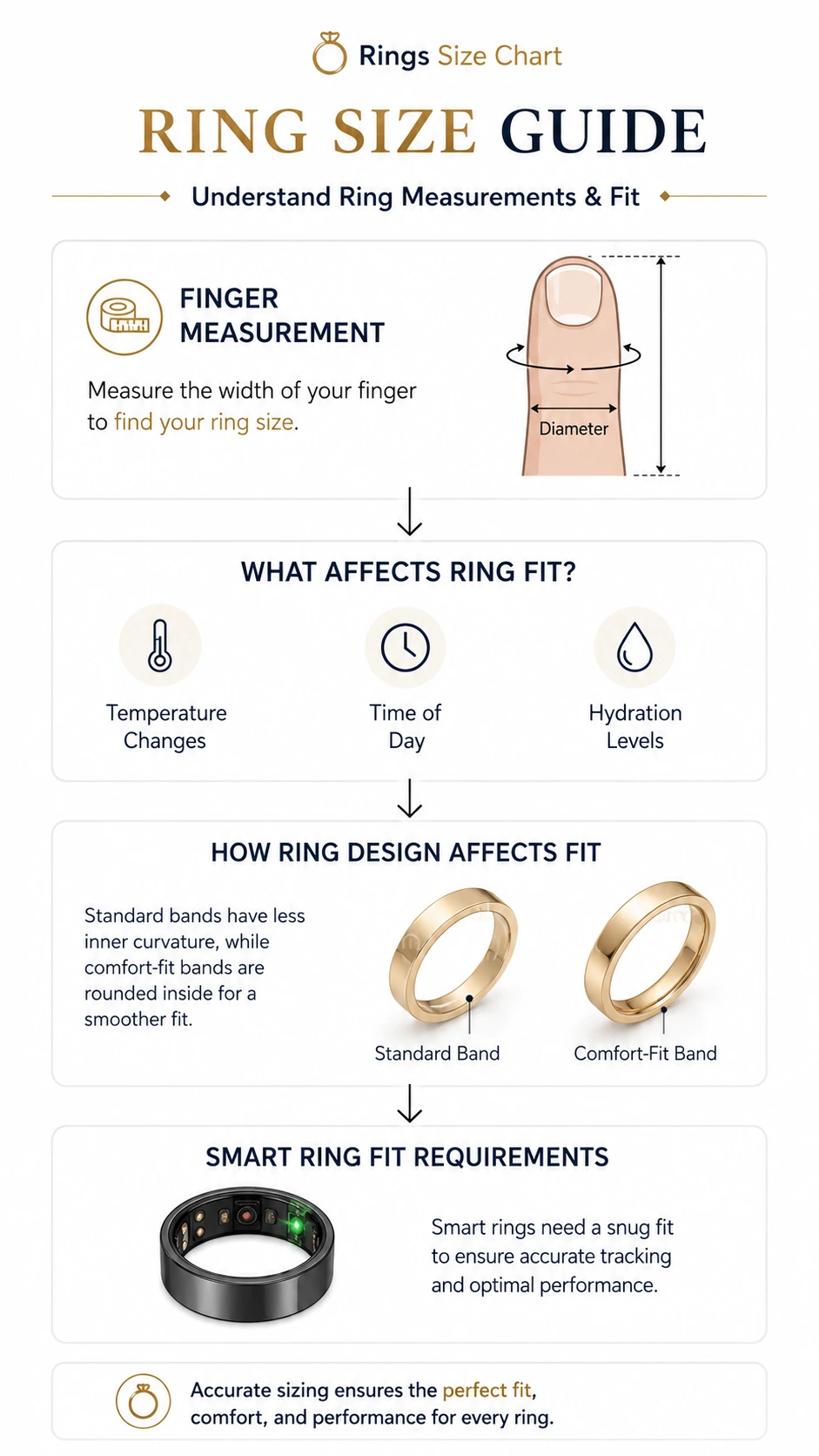
Cold fingers read small, and warm or swollen ones read large. Mid afternoon at room temperature is a safe time.
TAKE THE READING TWICE
Do it on two different days. If the numbers differ, use the larger one when you are between sizes.
USE PAPER OR STRING THAT DOES NOT STRETCH
Mark where the ends overlap, lay the strip flat against a ruler, and read the length in millimeters.
ALLOW FOR BAND WIDTH
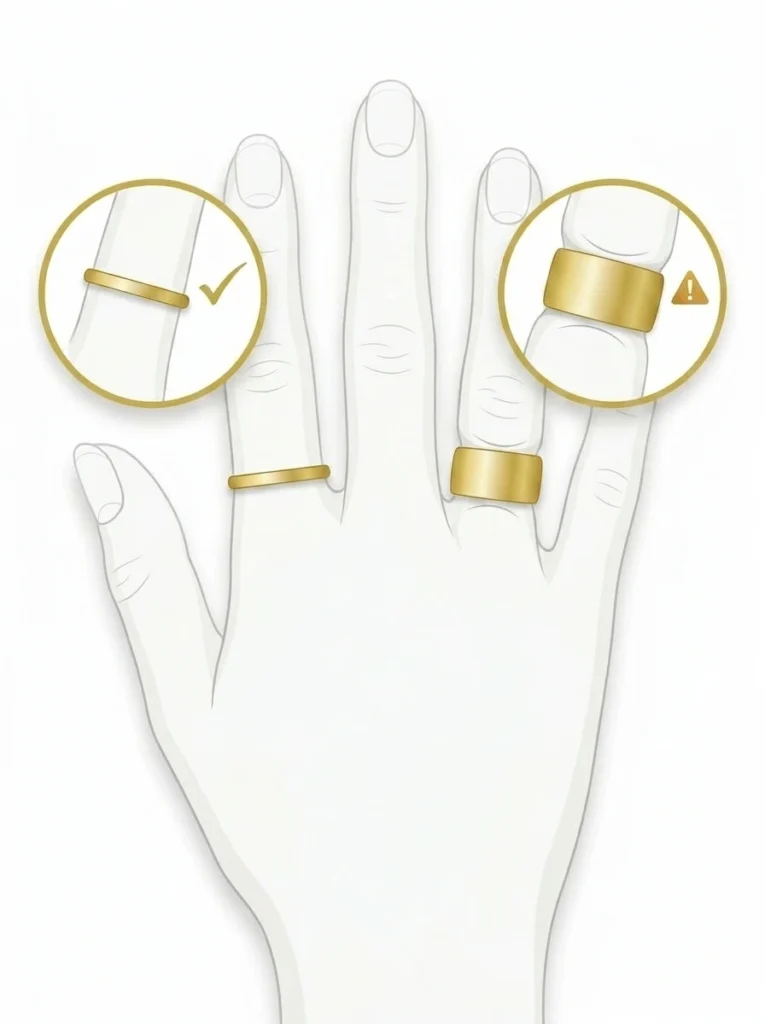
A wide band covers more of the finger and feels tighter than a thin one. For bands over about 6 mm, many people go up a quarter to half size.
COMPARE KNUCKLE AND FINGER BASE
If your knuckle is clearly larger than the base of the finger, pick a size that clears the knuckle but still stays put at the base.
MEASURE THE EXACT FINGER
Every finger has its own size, and your two hands differ too. Measure the finger and hand that will wear the ring.
Good to know: The usual average for women is US 6, a 16.5 mm inner diameter. For men it is commonly quoted between US 9 and US 10, which is 18.9 to 19.8 mm.
Choose the method that suits what you have on hand. If you can, try two of them and compare the numbers. Results within half a size of each other are a good sign, and a bigger gap means it is worth measuring again. Our ring size guides go deeper on each approach.
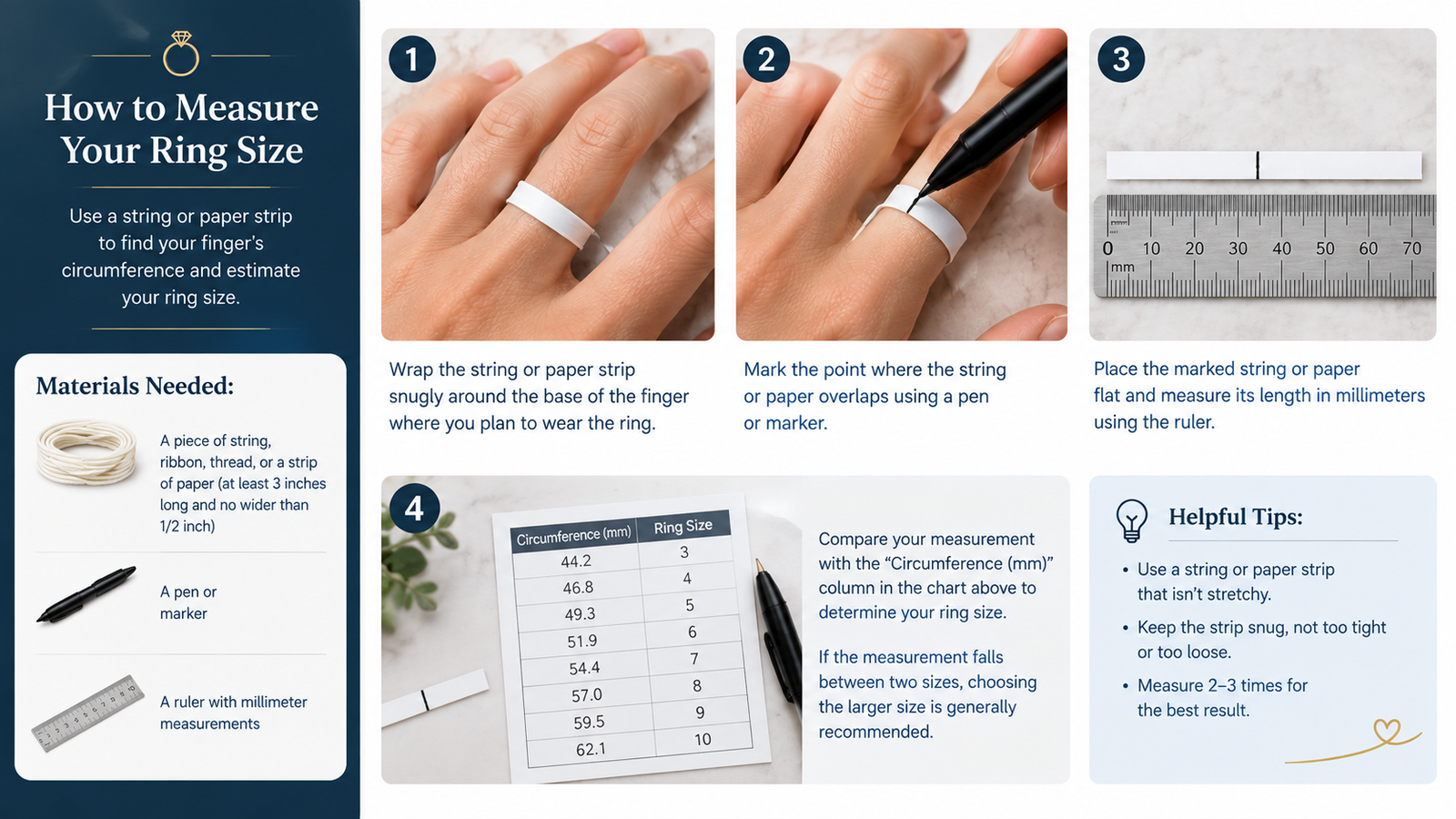
No special tools are needed. You will measure the distance around your finger and look it up in the circumference column of the chart.
Gather these:
String, dental floss or a paper strip that does not stretch, at least 8 cm (3 inches) long and no wider than 1.2 cm (1/2 inch)
A pen or fine marker
A ruler with millimeter markings
Steps:
Wrap the strip once around the base of the finger that will wear the ring. Pull it snug, but not so tight that it dents the skin.
Mark the point where the end meets the rest of the strip.
Slide the strip off, lay it flat, and measure from its end to your mark in millimeters.
Find that number in the Circumference (mm) column of the chart above. If it sits between two sizes, choose the larger one.
Tip: Do not stretch the string while wrapping, and repeat the measurement a few times, because fingers shift slightly through the day. Prefer a diameter? Divide the circumference by 3.14. A 51.9 mm circumference gives 16.5 mm, which is US 6.
Watch the string and paper method step by step:
If a ring already fits the right finger well, measuring the ring is quicker than measuring the finger. It is also the easiest way to find someone else’s size without giving away the surprise.
Gather these:
A ring that fits the correct finger well
A ruler with millimeter markings
A printable ring sizer, if you want a second check
Steps:
Set the ring on a flat surface where it cannot roll.
Measure the inside diameter in millimeters: the clear distance through the center of the opening, from one inner edge to the opposite inner edge.
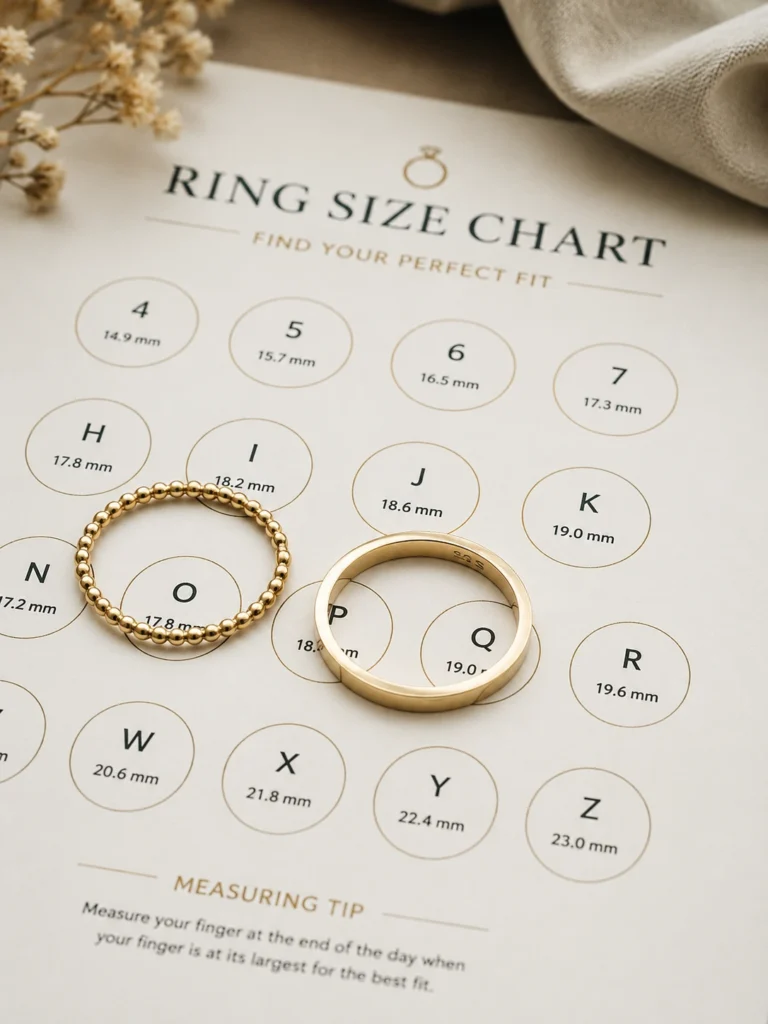
Optional: with a printed sizer, lay the ring over the circles and choose the one that fits the inner edge with no gap and no overlap.
Match your number to the Inside Diameter (mm) column in the chart above and take the closest size.
Tip: Measure inside the band, never across the outside edges. Use a ring with a width and shape close to the one you plan to buy, since a thick comfort fit band can feel different from a thin one.
A printable sizer lets you test your size without a trip to a jewelry store. Use it to measure your finger directly, or to check a ring you already own.
Gather these:
A printer
Scissors
Our printable ring sizer PDF
Steps:
Print at 100% scale. Choose Actual Size or No Scaling in the print settings and avoid “Fit to Page”, which resizes the sheet. Then run the scale check included in the PDF.
Use the sizer as instructed. A cut out strip wraps around your finger, and sizing circles are for laying an existing ring on top to find the closest match.
Read your result. Take the size shown on the sizer, or compare the measurement with our main ring size conversion chart.
Tip: Confirm the print scale before you trust the sheet. A page that printed only a few percent too small or too large will give the wrong size.
Most sizing mistakes come down to three small details.
Measure the finger and hand that will really wear the ring. Sizes differ from finger to finger.
Repeat the measurement, and skip it when your hands are cold.
Think about width. A wide band feels tighter than a narrow one at the same size.
These short videos show how a ring should sit on the finger, the sizing mistakes jewelers see most often, and how professionals take a measurement.
| Circumference | Ring size chart in mm | Ring Size Chart in cm | Ring Size Chart in inches |
|---|---|---|---|
| 49.3 mm | 15.7 mm | 1.57 cm | 0.62 in |
| 51.9 mm | 16.5 mm | 1.65 cm | 0.65 in |
| 54.4 mm | 17.3 mm | 1.73 cm | 0.68 in |
| 57.0 mm | 18.1 mm | 1.81 cm | 0.71 in |
| 59.5 mm | 18.9 mm | 1.89 cm | 0.74 in |
| 62.1 mm | 19.8 mm | 1.98 cm | 0.78 in |
(The complete ring size diameter chart for US 3 to 13 is in our printable ring size chart PDF.)
| US Ring Size | Inside Diameter (in) | Inside Diameter (mm) | Inside Circumference (mm) |
|---|---|---|---|
| US 3 | 0.554 in | 14.1 mm | 44.2 mm |
| US 4 | 0.586 in | 14.9 mm | 46.8 mm |
| US 5 | 0.618 in | 15.7 mm | 49.3 mm |
| US 6 | 0.650 in | 16.5 mm | 51.9 mm |
| US 7 | 0.681 in | 17.3 mm | 54.4 mm |
| US 8 | 0.713 in | 18.1 mm | 57.0 mm |
| US 9 | 0.744 in | 18.9 mm | 59.5 mm |
| US 10 | 0.776 in | 19.8 mm | 62.1 mm |
| US 11 | 0.807 in | 20.6 mm | 64.6 mm |
| US 12 | 0.839 in | 21.4 mm | 67.2 mm |
| US 13 | 0.870 in | 22.2 mm | 69.7 mm |
(Inner diameter and inner circumference for each US ring size. Circumference is roughly the diameter multiplied by 3.14.)
| UK Ring Size | US Ring Size | Inside Diameter (mm) | Inside Circumference (mm) |
|---|---|---|---|
| F | 3 | 14.1 mm | 44.2 mm |
| H 1/2 | 4 | 14.9 mm | 46.8 mm |
| J 1/2 | 5 | 15.7 mm | 49.3 mm |
| L 1/2 | 6 | 16.5 mm | 51.9 mm |
| N 1/2 | 7 | 17.3 mm | 54.4 mm |
| P 1/2 | 8 | 18.1 mm | 57.0 mm |
| R 1/2 | 9 | 18.9 mm | 59.5 mm |
| T 1/2 | 10 | 19.8 mm | 62.1 mm |
| V 1/2 | 11 | 20.6 mm | 64.6 mm |
| X 1/2 | 12 | 21.4 mm | 67.2 mm |
| Z 1/2 | 13 | 22.2 mm | 69.7 mm |
(UK ring sizes use letters. The US and UK scales are offset by about half a step, so a US size often sits between two UK letters, and some charts show the letter one half step lower.)
| Japan (JP) Size | US Ring Size | Inside Diameter (mm) | Inside Circumference (mm) |
|---|---|---|---|
| 4 No. | 3 | 14.1 mm | 44.2 mm |
| 7 No. | 4 | 14.9 mm | 46.8 mm |
| 9 No. | 5 | 15.7 mm | 49.3 mm |
| 11 No. | 6 | 16.5 mm | 51.9 mm |
| 14 No. | 7 | 17.3 mm | 54.4 mm |
| 16 No. | 8 | 18.1 mm | 57.0 mm |
| 18 No. | 9 | 18.9 mm | 59.5 mm |
| 21 No. | 10 | 19.8 mm | 62.1 mm |
| 23 No. | 11 | 20.6 mm | 64.6 mm |
| 25 No. | 12 | 21.4 mm | 67.2 mm |
| 27 No. | 13 | 22.2 mm | 69.7 mm |
(Japan ring sizes run on their own number scale, shown here with the matching US size and inner measurements. Full details are on our Japan ring size chart page.)
| Australia (AU) Size | US Ring Size | Inside Diameter (mm) | Inside Circumference (mm) |
|---|---|---|---|
| F | 3 | 14.1 mm | 44.2 mm |
| H 1/2 | 4 | 14.9 mm | 46.8 mm |
| J 1/2 | 5 | 15.7 mm | 49.3 mm |
| L 1/2 | 6 | 16.5 mm | 51.9 mm |
| N 1/2 | 7 | 17.3 mm | 54.4 mm |
| P 1/2 | 8 | 18.1 mm | 57.0 mm |
| R 1/2 | 9 | 18.9 mm | 59.5 mm |
| T 1/2 | 10 | 19.8 mm | 62.1 mm |
| V 1/2 | 11 | 20.6 mm | 64.6 mm |
| X 1/2 | 12 | 21.4 mm | 67.2 mm |
| Z 1/2 | 13 | 22.2 mm | 69.7 mm |
(Australian ring sizes use letters, like the UK scale, shown here with the matching US size and inner measurements.)
An app that turns a measurement into sizes for the US, UK, Europe, Australia, Japan and China.
Work in millimeters or inches, and measure by diameter or by circumference.
Compare your ring with the circle on screen until the edges match.
Get the US, UK, EU, Japan, China and Australia sizes in one view.
Keep your result, or send it to your jeweler, a friend or a family member.
A ring size chart pairs a physical measurement, either the inner diameter of a ring or the distance around a finger, with the size number or letter used in different countries. Find your measurement in one column and read the size from the next.
The main systems are US and Canada (numbers), UK and Australia (letters), Europe (the inner circumference in millimeters), and Japan (numbers on a separate scale). They start and step differently, so a ring size conversion chart is the safest way to translate one into another.
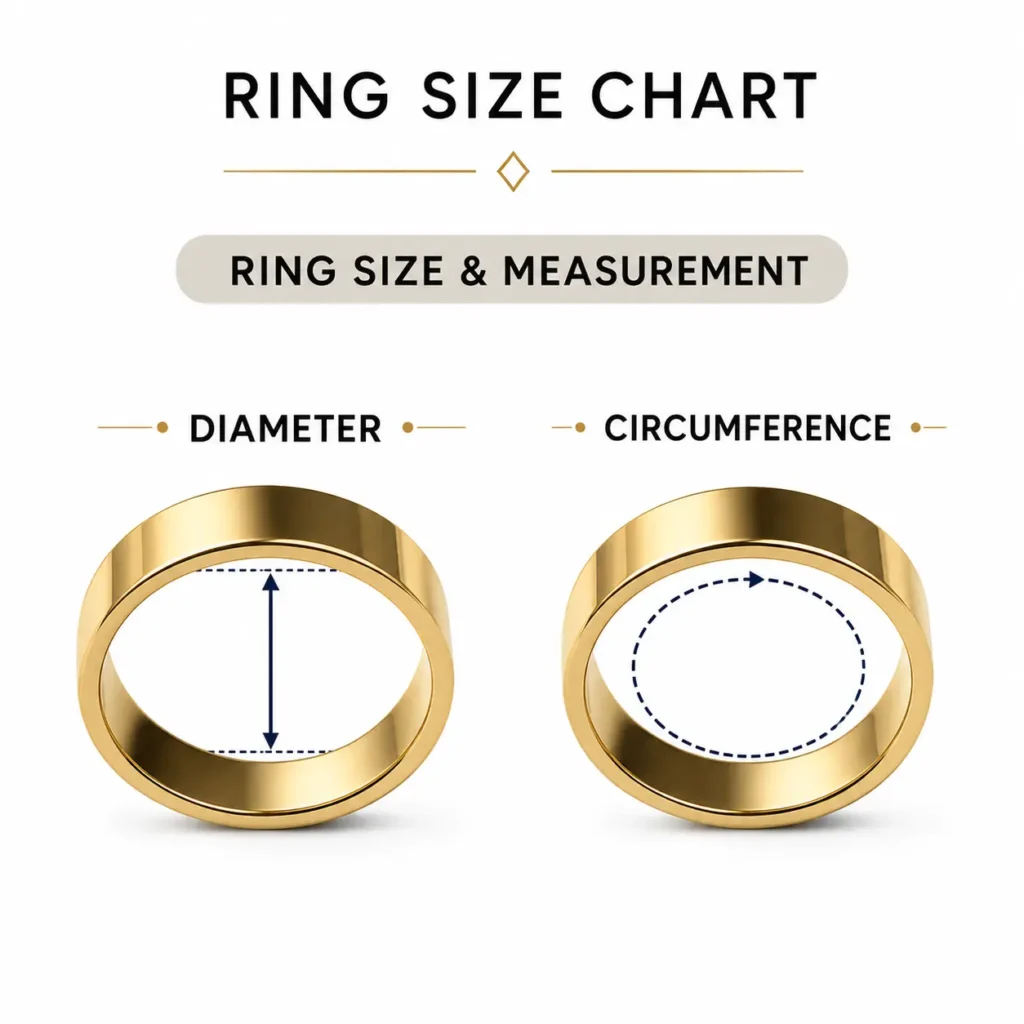
Inside diameter is the straight width across the opening, and circumference is the length around the inside edge. Multiply a diameter by 3.14 to get the circumference, or divide a circumference by 3.14 to go the other way. A 16.5 mm diameter works out to roughly 52 mm around. For centimeters, move the decimal one place: 16.5 mm is 1.65 cm.
A ring with a 16.5 mm inside diameter is a US size 6. That is also about UK L, EU 52 and Japan 11. Charts disagree a little on the UK letter and some list L ½, because the US and UK scales are offset by about half a step. For reference, 16.1 mm is US 5.5 and 16.9 mm is US 6.5.
Being measured by a jeweler with a sizer set is the most reliable route, ideally with a sample band as wide as the one you want. At home, measuring a ring that already fits the same finger is usually more accurate than wrapping string, because there is no stretch or overlap error. Take every measurement when your hands are at normal temperature, not cold or swollen.
No. Ring sizes are not split by gender, and the same scale applies to everyone. Men’s averages are higher, around US 9 to 10 against about US 6 for women, simply because finger widths differ. Men’s bands are also often wider, which can call for a larger size. What matters is the individual finger.
Look at the width of the ring. A wide band usually fits better in the larger size, while a thin band can work in the smaller one. If you cannot try both, go up, because a slightly roomy ring is easier to live with and adjust than a tight one.
Take a size you already know, or a measurement in millimeters, and find it in the column for its system. Then read across the same row to the size in the system you need. The diameter and circumference columns confirm you are on the right row. If a size sits between two rows, check the width of the ring before choosing.
Yes. Convert to millimeters first, because the charts use them: multiply inches by 25.4. For example, 0.65 inches is 16.5 mm, which is US 6. The calculator above also has an inch version, so you can skip the maths.
Yes. The charts and the calculator on this page are free to use, and a printable version is available through the download button. Whichever chart you use, look for clear millimeter measurements and follow its instructions closely. Sizing something other than a finger? We also have a toe ring size chart and a nose ring size guide.
Diameter is the width across the inside of the ring, and circumference is the distance around that inner edge. They describe the same size in two ways. Use diameter when you are measuring a ring, and circumference when you are wrapping something around a finger.
Not exactly. Oura numbers its sizes on its own scale, so an Oura ring size chart is not the same as a jewelry chart. Use Oura’s sizing kit, wear the sample rings for a while on the finger you plan to use, and then order.
It is a chart you print and use at its true physical size, so you can hold a ring against the printed circles and compare directly. It only works if the print scale is exact, so print at 100% and confirm the scale before you rely on it.
In the print dialog choose 100% scale, Actual Size or No Scaling, and never “Fit to Page”. After printing, check the scale reference on the sheet. A bank card is 85.6 mm wide, which makes a handy test: hold it against a printed ruler. If the length is off, adjust the settings and print again.
A Cartier 54 is about a US size 7. Cartier’s number is the inner circumference in millimeters, and 54 mm equals a diameter of about 17.2 mm, close to US 7 at 17.3 mm. Fit still depends on the band, so confirm with Cartier’s guide or a boutique before buying.